
Company Culture Is a Collective Act: Four Everyday Moves That Build the Workplace You Want
We’ve all seen it. The beautifully designed values posters in the lobby. The inspiring purpose statement in the email signature. The town hall where leadership announces, with genuine conviction, that “people are our greatest asset.”
And then… nothing really changes.
The same behaviours get rewarded. The same voices dominate meetings. The same frustrations simmer just below the surface. This happens because culture isn’t a statement or wishful thought. It’s a set of shared, repeatable actions. Aspirations and vision statements are important, but they should never be confused or sold as the current reality. Words matter and actions count because culture is a lived experience.
According to Deloitte research, 88% of employees believe culture drives success (2021). Yet most culture initiatives fail to move the needle because they focus on messaging rather than movement. Organizations try to write them into existence rather than build and reinforce them through action.
The good news? A handful of small, easy, everyday moves can compound into a very big difference. And those moves don’t belong to the CEO or HR alone; they belong to everyone.
Key Article Takeaways:
- Culture isn’t a statement, it’s a set of shared, repeatable actions. The key is to focus your efforts on the moments that create movement.
- Four everyday actions build positive culture momentum: Seek the Truth (understand your reality), Elevate Others (recognize what you want repeated), Make It Memorable (design moments that stick), and Spark Together (unlock collective intelligence).
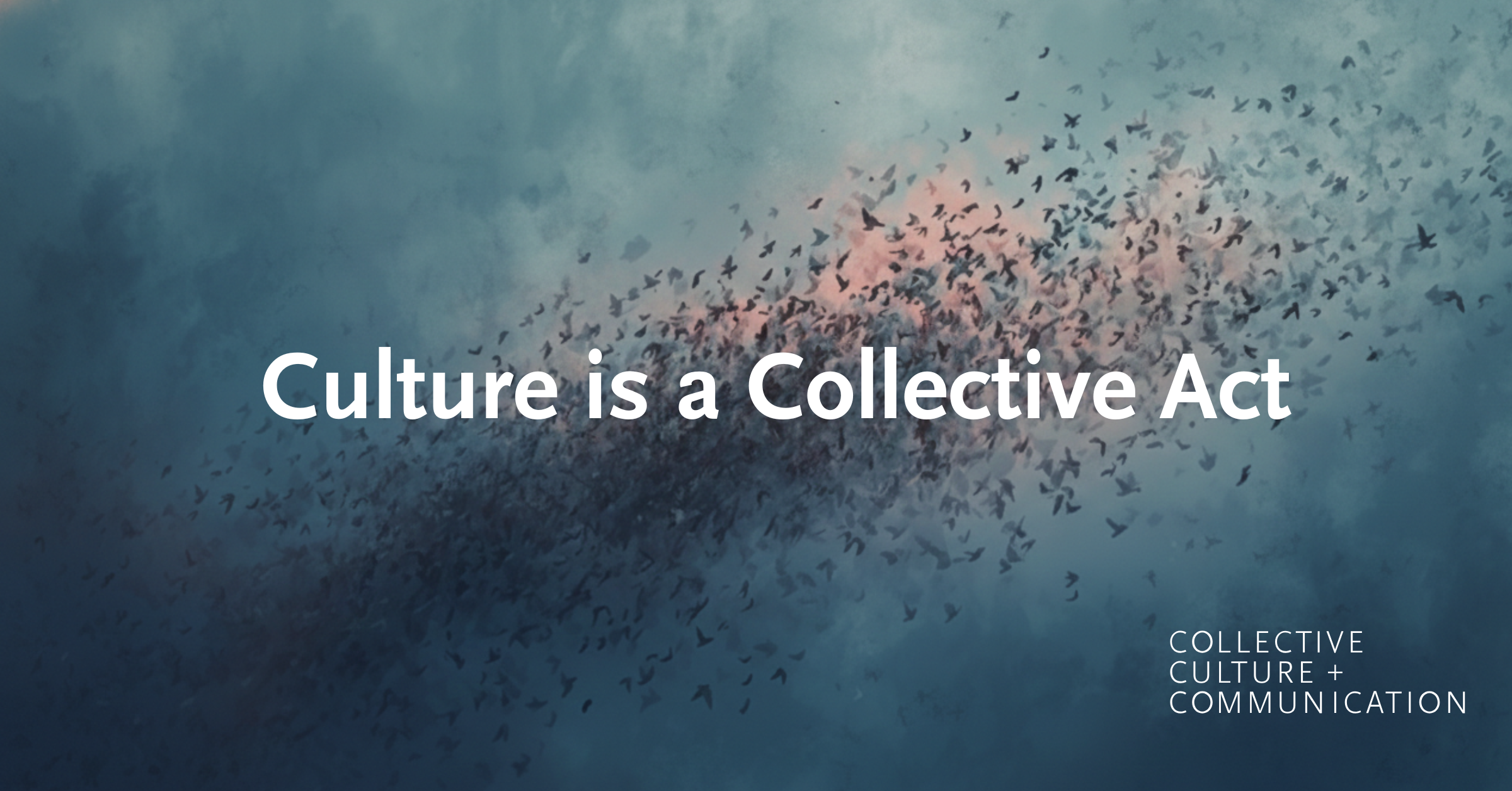
- Small moves compound. Like starlings in a murmuration, each person responding to those nearest them creates extraordinary organizational patterns.
- Start with one action this week. Pick the spot where you’ll have the most impact and commit to one concrete move by Friday.
Culture as a Collective Act
Culture is a collective act, but leadership sets the conditions for it to thrive. Your CEO doesn’t own culture, but they shape it by setting the tone, legitimizing behaviour, and creating the systems, incentives, and trade-offs where it shows up. Real culture change happens across four interconnected dimensions: building trust at the core, creating clarity about direction, strengthening connection across teams, and enabling true collaboration.
Think of a murmuration of starlings. Thousands of birds creating stunning, fluid patterns across the sky. Each one responds to the seven birds nearest to them, and that local coordination creates something extraordinary. Workplace culture works in a similar way. Small, everyday interactions compound into the patterns that define how your organization moves.
If culture is “how we do things around here,” then it’s shaped by what we see, celebrate, remember, and create together. It’s the accumulation of a thousand small decisions like:
- who gets recognized
- whether meetings and interactions feel safe
- what moments stick in people’s memory
- how ideas move from conversation to action
This means culture change isn’t only about cascading a new message from the top. Setting the tone matters, but culture is ultimately shaped by what leaders model and what people live every day.
Culture in Action
Real change happens when every leader, manager, and team member has a few powerful moves they can practice daily. Moves that build trust at the core, create clarity about direction, strengthen connection, and enable real collaboration. Think of these as culture verbs. Practical actions that anyone can take to shift the story your halls tell.
Here are four collective culture actions that consistently build positive momentum. They’re not everything, but they build a solid foundation.
- Seek the Truth: Before you can shape culture, you must first see it clearly
- Elevate Others: We rise by lifting others
- Make it Memorable: People will remember how we make them feel
- Spark Together: Through safety and connection, we unlock collective wisdom
Now, let’s dive into each of these culture acts.
1. Seek the Truth: Before You Can Shape Culture, You Must First See It Clearly
Imagine you’re watching a basketball game and your only job is to count how many times the players in white jerseys pass the ball. You’re focused. Diligent. Accurate.
And because of that focus, you completely miss the person in a gorilla suit who walks right through the middle of the court. “Wait – did you just say gorilla suit?!” Why, yes, we did.
This scenario is a famous study that was conducted by Simons and Chabris (1999) and it revealed something startling: half of the viewers were so focused on counting passes that they never saw the gorilla. The researchers concluded that “we perceive and remember only those objects and details that receive focused attention.”
Your workplace has gorillas too. Important truths that are invisible to you because you’re focused on your own “passes” (your priorities, your role, your daily pressures). And just like in the study, what’s invisible to one group may be impossible for another to ignore. Finance sees different gorillas than Operations. Night shift sees different gorillas than day shift.
This is why understanding your culture can’t come from a single survey or a leadership offsite. Different roles attend to different things. Listening across those roles, throughout your organization, is how you see and understand what’s really happening.
Putting it into Practice: The GORILLA Method for Listening
Here’s a simple framework to help ensure your culture understanding doesn’t miss the obvious:
G – Go wide
Talk to more than the usual suspects. Include different roles, shifts, locations, and levels of seniority. The people closest to the work often see what leadership can’t.
O – Open questions
Use neutral, open prompts that invite honesty:
- “What’s one thing that makes great work harder than it needs to be?”
- “What’s one thing we should never lose here?”
R – Reach the quiet voices
Proactively invite people who don’t normally speak up. Create a space where it feels safe to share what’s true, not just what sounds good.
I – Interpret patterns, not people
Cluster themes and remove names. Let people know that your goal is to fix systems, not to find out specifically who thinks what. When you focus on patterns, people trust you’re listening to improve, not to judge.
L – Loop back
Tell people what you heard and what you’re going to try: “This is what you told us. Does that feel accurate?” No loop-back risks losing any trust that was built in the process and can result in a wasted effort.
L – Link to one concrete change
Choose one visible action that’s achievable in a short timeframe. Small and fast beats perfect and slow.
A – Ask again
Schedule the follow-up. “Did this help? What’s better? What’s unchanged?” Truth-seeking is a habit, not a one-time exercise.
When you seek the truth this way, you build a shared reality and that’s the foundation every other culture move relies on.
2. Elevate Others: We Rise by Lifting Others
If culture is “how we do things around here,” then recognition is how we teach that in real time. What gets recognized gets repeated. What gets repeated becomes “just how we do things.”
Because of this, leaders and peers are sitting on free culture fuel and not using it. Why? Because we underestimate the impact of recognition. We’re not talking about glazing here(!), but real, authentic acknowledgement.
Research by Boothby and Bohns (2020) found that people consistently underestimated how positive and meaningful their compliments felt to receivers. They also overestimated how awkward it would be, so they gave less recognition than they should have. We think, “It’s not a big deal” or “They already know they’re good” or “That would be weird to say.” But the science says that’s incorrect, and it lands harder than you think.
The business case is clear too. Employees who receive meaningful recognition are 45% less likely to leave within two years (Gallup, 2024). Recognition is a top driver of engagement, which links directly to higher productivity, profitability, and fewer safety incidents.
When Doug Conant took over Campbell Soup in the early 2000s, performance and morale were tanking. Over his 10-year tenure as CEO, he wrote more than 30,000 handwritten thank-you notes to employees at all levels, recognizing very specific contributions tied to their goals and values. Many factors drove Campbell’s turnaround, but Conant and others consistently highlight recognition and respect as central. Those notes were a visible symbol of a new norm: leaders notice. People matter. Results and respect go together.
Putting it into Practice: Elevate Others in Three Simple Steps (SPOT – NAME – AIM)
- SPOT what’s worth repeating
Look for behaviours that reflect your values or make others’ work better. Catch people doing things right. - NAME it in the moment
“When you did [X], it had [Y] impact.” Be specific. Vague praise feels hollow; specific recognition feels real. - AIM it at the future
“This is exactly what we need more of as we do [Z].” Connect their action to where the team is going. This turns recognition into culture reinforcement.
If culture is a collective act, then elevating others clearly and often is one of the most practical and economical ways every person can shape it.
3. Make It Memorable: People Will Remember How You Made Them Feel
People don’t remember every email, every policy update, or every standard Tuesday meeting. But they do remember a few powerful moments, and especially how things end.
The moments we design at key points in the employee journey are how we encode what we stand for. A first day that feels genuinely welcoming. A difficult announcement that ends with clarity and support. A feedback conversation that connects someone’s work to real impact.
Research on memory shows four principles that make experiences stick:
- Emotion – Moments with clear emotional tone are encoded more strongly than neutral ones. If your important touchpoints feel flat or confusing, they won’t stick in the brain or in the culture. (Kensinger, 2009)
- Peaks & Endings – We don’t average every second of an experience. We remember the high point and how it ends. A strong, thoughtful ending can redeem a difficult experience; a sloppy ending can sour an otherwise fine one. (Fredrickson, 2000)
- Distinctiveness – Known as the Von Restorff effect, our brains flag what breaks the pattern. One small, thoughtful, novel detail is more memorable than 10 generic gestures.
- Meaning & Connection – A meta-analysis of memory research confirms what many of us intuitively know: we remember moments that tell us something about who we are and whether we belong (Symons & Johnson, 1997). A small gesture that says ‘you matter here’ sticks longer than a perfectly formatted policy email.
Putting it into Practice: Design Moments That Stick
Audit your key moments: first days, exits, promotions, tough changes, wins. Ask:
- Does this moment have clear emotional tone, or is it just transactional?
- Are we ending it well, or does it just… stop?
- Is there one distinct, human touch that will make it memorable?
- Does it reinforce belonging and meaning?
Then redesign one. Just one. Make it warmer, clearer, more distinct, more human. When you do this intentionally, you’re not just creating a nice moment, you’re writing the stories people will tell about what it means to work here. When they do that, they’re really expressing the culture to others.
4. Spark Together: Through Safety and Connection, We Unlock Collective Wisdom
Once you’ve built shared understanding (Seek the Truth), created safety through recognition (Elevate Others), and designed cohesion through memorable moments (Make It Memorable), you’ve laid the groundwork for something powerful: true collective intelligence.
Google’s Project Aristotle found that psychological safety and equal turn-taking were hallmarks of top-performing teams. When teams balance the floor and read the room, as a group, they think smarter together than the smartest person in it.
But here’s the twist: traditional brainstorming often fails. When ideas are shared out loud from the start, groupthink, status bias, and the loudest voices take over. Research by organizational psychologists Paul Paulus and Bernard Nijstad shows that brainwriting (generating ideas independently before sharing) consistently produces more ideas and higher-quality outcomes than open discussion or working alone.
Putting it into Practice: Spark Together for Better Outcomes
Use this four-step process to unlock your team’s collective intelligence:
- Silent Brainwriting
Give one prompt and have everyone capture ideas independently. This preserves diversity and avoids status bias before anyone talks. - Round-Robin Shares
Everyone contributes once with equal turns. No cross-talk. Optional: paraphrase the last speaker before adding yours. This ensures all voices are heard. - Cluster & Exploration
Name 2–3 themes that emerge, then pull in a perspective from beyond the room – a customer, another department, or research. This breaks echo chambers. For instance, Jeff Bezos always kept an empty chair in Amazon meetings to represent the customer as “the most important person in the room.” - Commit to Test
Pick the simplest change you can try this week. Name an owner, a metric, and a check-in date. Small experiments beat perfect plans.
When you run meetings this way, the quiet person with the breakthrough idea finally speaks. The group gets smarter. And people leave feeling heard, not steamrolled.
The Loop That Changes Everything
Culture isn’t what’s written on the walls, it’s what walks through the halls. And when we strengthen one step in this loop together, the whole system gets stronger and the story in your halls changes.
We seek the truth to build a shared reality. We elevate others so the right behaviours spread. We make it memorable so the moments people retell actually match the values. And we spark together, running small tests that make the group smarter than any one individual.
Most organizations try to fix culture with messaging. But culture isn’t changed by words alone. It’s built by walking your way there. One small, repeatable, intentional action at a time.
Here’s our Collective Challenge:
Pick one spot in that loop. Choose one action you can take by Friday, name it, try it, and notice what changes.
If even a handful of people in your organization do that, the walk in your halls will start to shift long before any new slogan on the wall ever could.
Want to dive deeper? Contact us for a free culture consultation.