
The Invisible Infrastructure of Culture
Culture eats strategy for breakfast, Peter Drucker famously said. But what exactly is doing the eating? Most leaders can’t name it. They point to behaviours, values posters, or “the way we do things.” But there’s something deeper… an invisible infrastructure of beliefs that determines which strategies get digested and which get spit out.
Let’s say that your organization launched a culture initiative 18 months ago. The well thought out roll-out included new values, leadership training, town halls and other activation initiatives. You saw initial enthusiasm in the surveys, but as time goes on, you’re seeing that not much has truly changed. The same behaviours keep persisting and the same frustrations simmer beneath the surface.
There’s a good reason why that’s happening and it’s because you’ve been trying to change culture at the wrong level. And you’re not alone. Most culture work fails because it targets what’s visible while ignoring the invisible force driving those behaviors.
In this article, we’re going to pull back the curtain on that invisible force. We’ll discuss what it is, why it’s such a strong force, and how to start working with it instead of against it.
Key Article Takeaways:
- Culture doesn’t root from behaviours or values statements. It originates in the underlying beliefs people hold about how things work and those beliefs are shaping everything you see on the surface.
- When values and beliefs conflict, beliefs always win. Psychology’s cognitive behavioural loop explains exactly why, and it’s the reason most culture initiatives stall despite good intentions.
- Beliefs don’t change through messaging alone. They change through repeated experience. The path to real culture shift starts with seeing the beliefs that are already at work, then designing the small, consistent actions that interrupt those beliefs and create new evidence for a new one.
Where Culture Originates
To understand why culture initiatives struggle, we need to look at the root of where culture originates. To get a better understanding, let’s turn to Edgar Shein, organizational psychologist, who identified three levels of organizational culture:
Level 1: Artifacts: What you can see, hear, and touch. The open office layout, the casual dress code, the ping pong table, the all-hands meetings. These are the most visible elements of culture, and they’re what many organizations focus on when they want to “improve culture.”
Level 2: Espoused Values: What the organization says it stands for. “We value innovation.” “People are our greatest asset.” “We embrace failure as learning.” These show up on walls, in presentations, and in job postings.
Level 3: Underlying Basic Assumptions: The unspoken truths people hold about how the organization works. These assumptions determine which behaviours feel safe, smart, or risky. They’re invisible, but they’re the infrastructure holding everything else up.
Herein lies the problem as most culture change initiatives operate at levels 1 and 2. We redesign the office, update the values, train the leaders. Meanwhile, culture originates at level 3, quietly determining whether any of those changes stick.
Schein called these basic assumptions – the deepest layer of culture. We call them beliefs, because that’s what they are: the things we hold to be true about how things work here.
When Beliefs and Values Collide
Beliefs aren’t just abstract philosophy. They’re the operating system running in everyone’s heads. And when values and beliefs conflict, beliefs always win.
Consider this scenario: Your organization proudly declares “we value innovation” on every surface. The CEO talks about it. It’s in the performance review template. But underneath, there’s a different belief circulating: “don’t be the one who gets it wrong.”
So, what happens in this organization? Despite the messaging, despite the good intentions, innovation doesn’t show up. People don’t speak up in meetings. They don’t propose bold ideas. They don’t challenge the status quo. Not because they don’t want to, but because their belief about what’s safe drives their behaviour more powerfully than any value statement ever could.
This dynamic comes directly from psychology. In cognitive behavioural therapy (CBT), therapists work with something called the cognitive behavioural loop: beliefs generate thoughts, thoughts generate feelings, feelings drive actions, and actions produce outcomes that reinforce the original belief. It’s a self-perpetuating system.
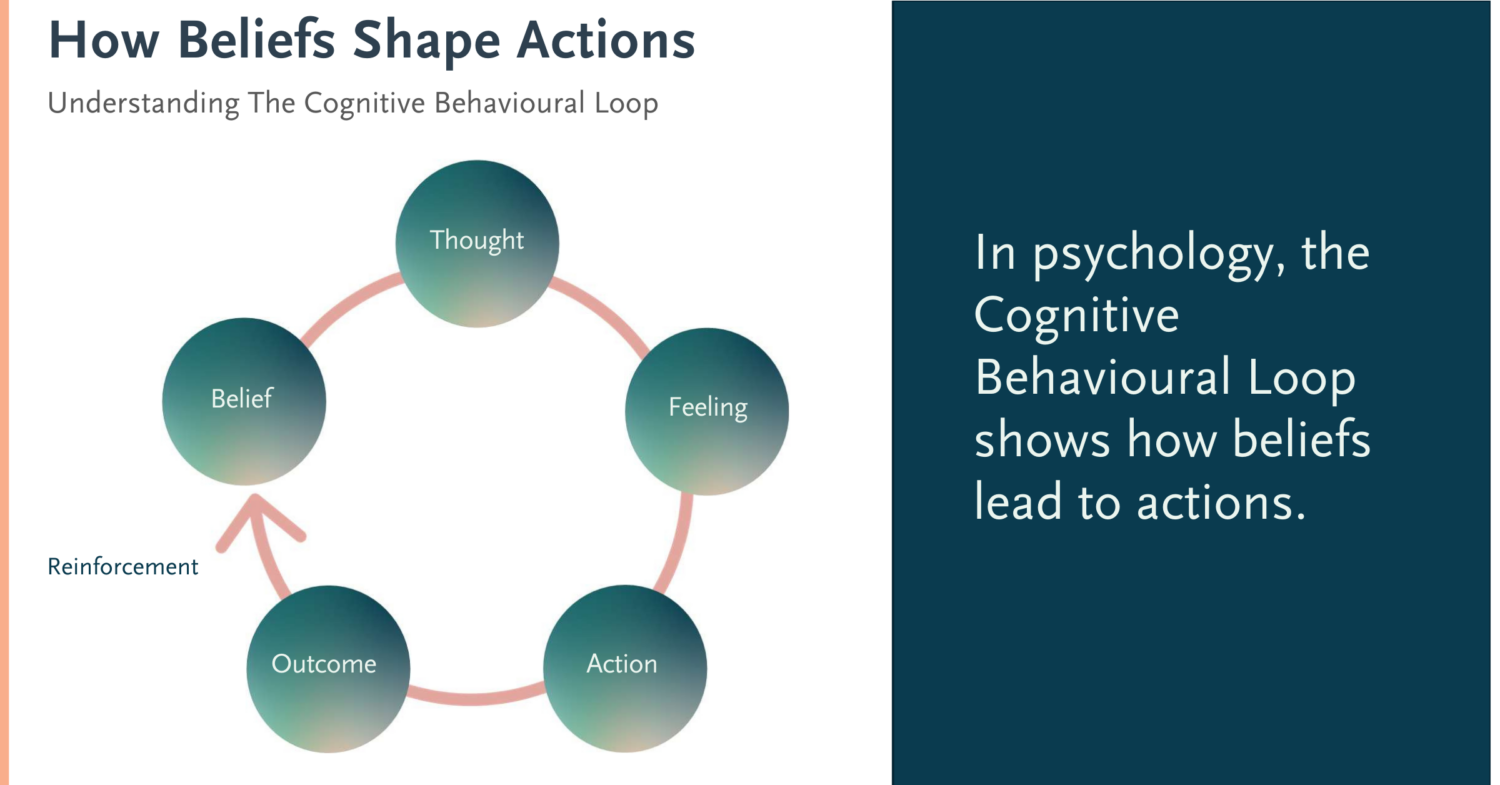
In individuals, this might look like: “I’m not good enough” (belief) → “If I speak up, I’ll sound stupid” (thought) → anxiety (feeling) → staying silent (action) → missed opportunity (outcome) → “See, I really can’t do it” (reinforced belief).
The same principle operates in organizations. When people collectively believe “Leaders don’t care about our input,” they think “Speaking up won’t change anything,” so they feel disengaged, stay silent in meetings, and then watch as leaders make decisions without input, reinforcing the original belief that their voices don’t matter.
The opposite is equally true. When people believe “Employee voices matter here,” they think “If I share an idea, it will be listened to,” they feel safe to speak up and contribute openly, they see leaders acting on input, and the belief gets stronger with each cycle.
Seeing the Invisible: How Beliefs Show Up
So how do you identify the beliefs operating in your culture? You look for the signals which are the patterns of behaviour that reveal what people may believe beneath the surface. Here are some examples of what could be showing up:
Collaboration & Silos
- Scenario A:
- Signal: Teams openly share information, cross-functional projects run smoothly, recognition goes to groups not just individuals.
- Potential belief: “Other teams are partners; when we share knowledge, we all win.”
- Scenario B:
- Signal: Teams hoard information, duplicate work, resist collaboration.
- Potential belief: “Other teams are competitors; if I share, I’ll lose my edge.”
Leadership Trust
- Scenario A
- Signal: Employees engage with leader messages, leaders follow through on commitments, positive informal conversations about leadership.
- Potential belief: “Leaders care about us; what they say matches what they do.”
- Scenario B
- Signal: Cynicism about leader intentions, low trust scores, skepticism in response to announcements.
- Potential belief: “Leadership doesn’t care; what’s said publicly doesn’t match what happens privately.”
Psychological Safety
- Scenario A
- Signal: People admit mistakes and share lessons learned, concerns get raised early, healthy debate happens without fear.
- Potential belief: “Mistakes are opportunities to learn; speaking up leads to improvement.”
- Scenario B
- Signal: Mistakes get hidden, issues don’t surface until they’re crises, silence in meetings.
- Potential belief: “Mistakes equal weakness; you’ll get blamed if you speak up.”
The diagnostic question that can cut through the noise: If this is our stated value, what belief would produce the behaviours we’re seeing?
How Beliefs Change
Being communicators, the importance of communicating the right message is ingrained in our DNA. However, you can’t change beliefs with messaging alone. One of our favourite sayings at Collective is “words matter, actions count.” It’s a favourite because it’s true.
No amount of town halls, posters, or training sessions will shift the underlying assumptions people hold about the organization until the actions of those in influence change too.
Beliefs change through repeated experiences, not just words. They shift when people encounter evidence, over and over again, that contradicts and interrupts what they currently believe.
When Satya Nadella became CEO of Microsoft in 2014, the company was known internally for a culture of competition. The stack ranking system, where employees were forced to compete against each other for performance ratings, had created a prevailing belief: “Collaboration is risky. If someone else succeeds, it costs you.”
Nadella didn’t just announce a new culture. He eliminated stack ranking, and then, consistently over years, modelled the behaviour himself, publicly sharing his own mistakes, asking questions instead of having all the answers, and framing setbacks as learning (Nadella, 2017).
No single moment changed Microsoft’s culture. It was the relentless repetition of actions that contradicted what people had long believed to be true until eventually, the belief itself began to shift.
Small actions, repeated consistently, create new patterns of evidence. People start to notice that speaking up in meetings leads to action. That collaboration gets recognized. That leaders follow through. And slowly, the belief begins to shift.
Not because someone told them it should, but because they’ve experienced something different enough times to update their mental model of how things work here.
This is where the four culture actions from our previous article comes into play: Seek the Truth, Elevate Others, Make It Memorable, and Spark Together. Each one is an opportunity to create the kind of repeated experiences that shift beliefs.
When you consistently seek the truth through broad listening, you build the belief that voices matter.
When you elevate others with specific recognition, you reinforce that the right kind of contribution is noticed.
When you consistently design memorable moments, you encode new assumptions about belonging.
When you spark together with psychological safety, you prove that collaboration works.
The Work Ahead
Your culture initiatives haven’t failed because you did them wrong. They’ve struggled because they were aimed at the wrong target. Values statements and leadership training are important components, but they operate at the surface. Culture lives in the invisible infrastructure of beliefs, and it is this structure that supports everything else.
The good news? Once you see where culture originates, you can start to shape it intentionally. Not only through messaging, but through the small, repeated actions that create new patterns of evidence.
Putting it into Action
Choose one belief in your organization you want to shift. Identify the signal that would reveal it’s changing. Then design the smallest repeatable action that creates evidence for a different belief. Do that action consistently. Watch what shifts.
For example: If the belief is that mistakes should be avoided, the signal may be asking, “what did we learn and what can we do differently next time?” What this looks like in real life is a pause on blaming and a focus on what really matters, moving forward.
If you want to understand or shift your culture, don’t start with your values. Start with the beliefs that are already shaping behaviour.
If you’d like to map the beliefs operating in your culture, contact us for a free consultation.